The conversation about hidden commissions in offshore sourcing usually focuses on margin. Buyers worry their agent is pocketing money from the factory side on top of the fee they already pay. That worry is reasonable.
A bigger problem sits underneath it. The same sourcing arrangement that hides the commission usually hides the factory. A quality audit cannot read a manufacturer’s track record on a factory it does not know.
The margin question is real. The quality question costs more, and almost no Kickstarter creator looks at it.
Two sourcing topologies
A US importer gets a product made in Asia one of two ways.
Direct-to-factory. The buyer knows the factory by name, address, ISO 9001 scope, and recall history. A paid representative can handle daily work, and the buyer still sees the production site.
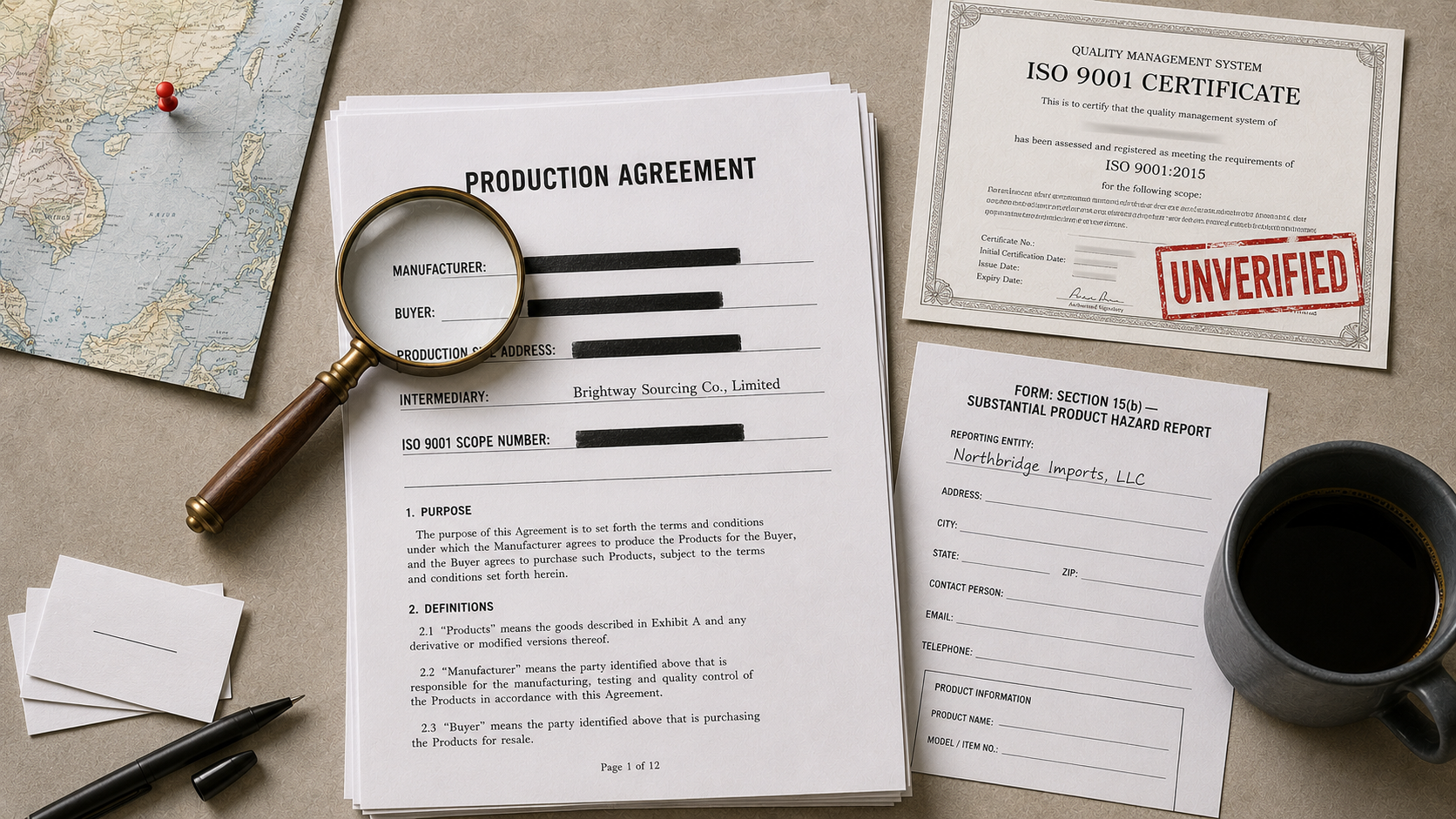
Through an intermediary. The buyer’s contract is with a trading company or agent. The agent picks the factory and places the order. The buyer often does not know which factory builds the product. The agent’s compensation sometimes includes factory-side payments that never appear on any invoice the buyer sees.
Both setups can work. A trading company acting as a single factory’s named sales arm, with full transparency, is fine. A direct factory relationship that ships inconsistent product is worse than a transparent agent. The dividing line is visibility, not contract structure.
Three opacities to look for
When a pre-launch audit cannot complete, the failure is usually one of three.
1. The factory is not named. The buyer knows the trading company. The production site is not in the agreement. Recall history searches do not run.
2. The factory is named but cannot be visited or audited. Site visits get postponed. Third-party inspectors are turned away. Production-line access during the run gets blocked, and communications run through the agent’s filter.
3. The agent’s compensation is not fully disclosed. The buyer pays a fee or markup. The factory pays the agent separately. The agent’s incentive to push the factory on quality is weak when the factory-side payment is the larger of the two.
Any one of the three blocks a real pre-launch audit. All three together leave the buyer carrying the full recall risk with no tools to manage it.
Why opacity breaks the audit
The Pre-Launch QA Audit runs in 10 sections. Three of them depend on knowing the factory.
Section 1. Materials and Construction. Reads the BOM line by line. Component supplier names are needed to verify food-contact, fire-rating, and material certifications. Trading-company BOMs often strip those names out.
Section 3. Failure Modes. The same spec sheet produces different defect rates at different factories.
Section 4. Manufacturer Track Record. Fails completely when the factory is not named. The audit pulls CPSC, FDA, USDA, and NHTSA recall history for the named factory. None of that runs against “the trading company’s factory in Shenzhen.”
When Section 4 cannot run, the recommended actions are direct. Get the factory name in writing. Commission a third-party factory audit from SGS or Intertek. Verify the ISO 9001 certificate through an accredited registry. Each one is a cost the buyer pays because the sourcing arrangement did not deliver visibility from the start.
The rotating-workshop problem
A specific cost shows up when a trading company places the same order with several small workshops. The buyer sees identical packaging. The quality engineer sees different process discipline, different solder profiles, different defect rates from batch to batch, and no way to predict which workshop builds the next run.
A pre-shipment inspection on one batch tells the buyer nothing about the next. Returns cluster on the lower-discipline workshops. The buyer reads the variance as “manufacturing inconsistency.” The inconsistency is structural to the sourcing layer.
Federal exposure the creator still owns
A common assumption is that an opaque sourcing arrangement shields the US importer from US regulators. The reverse is true.
CPSC reporting duty. Under 15 USC § 2064(b), an importer must report a substantial product hazard within 24 hours. CPSC’s published guidance is explicit that “manufacturer” includes the importer. Civil and criminal penalties attach to the importer.
Customs reasonable care. Under CBP’s reasonable-care standard, the importer is responsible for every entry the broker or agent files. Reasonable care cannot be delegated.
FCPA does not cover this. The FCPA prohibits payments to foreign government officials, not commercial bribery between private parties. The DOJ Resource Guide is clear on the scope. State commercial-bribery statutes and the Travel Act reach US-side participation in commercial bribery in many fact patterns, but that is counsel territory. The narrow point: absence of FCPA exposure does not equal absence of legal exposure.
US regulations place primary responsibility on the importer. Delegating sourcing visibility does not delegate the regulatory exposure of the importer-of-record role.
What transparent sourcing looks like
The healthy alternative is straightforward. The buyer needs to see and verify what is happening, without necessarily talking to the factory every day. The factory is named in the production agreement with verifiable address and accreditation scope. The agent’s compensation is fully disclosed in writing, with a representation against undisclosed factory-side payments. The factory accepts third-party audits and pre-shipment inspections on the production line. The ISO 9001 certificate is verifiable through an accredited registry. Major US retailers require this anyway. Walmart, for example, requires supplier factory disclosure and authorized-facility audits, and subcontracting to an unauthorized facility makes a supplier ineligible.
A creator who wants to sell into US retail hits these requirements eventually. The cheap path is to build the discipline in before the deposit clears.
Sourcing health check
Seven questions a creator can answer in 30 minutes against any sourcing arrangement.
| Question | Why it matters | What you want |
|---|---|---|
| Who is the named manufacturer? | Section 4 of the audit cannot run without it. | A named factory with verifiable address and ISO scope. |
| Is the ISO 9001 certificate current? | Independent signal of process discipline. | Verifiable through an accredited registry, not a PDF. |
| Has the factory been recalled in the past five years? | Recall history is the single most predictive QA input. | Clean record, or a documented remediation. |
| Can an inspector access the line during the actual run? | Inspection is only useful if it covers the line that built the units. | Written commitment, scheduled before the run. |
| Is the agent’s compensation fully disclosed? | Misaligned incentives drive decisions you cannot see. | Written fee structure with a no-undisclosed-payments clause. |
| One factory, or rotation across workshops? | Rotation breaks defect-pattern analysis. | One named line in one named facility. |
| Who is the importer of record? | CPSC reporting and CBP reasonable care fall on the importer. | The buyer, knowingly, with procedures in place. |
Three or more “no” answers means the sourcing arrangement needs restructuring before the PO clears. One or two are usually fixable with explicit follow-up in writing.
What the audit can and cannot do
The audit needs the manufacturer’s identity, the production line, and the compensation structure of every party in the middle. When that information exists, the audit runs to completion. When it does not, the audit cannot perform the close-out actions for the buyer. It tells the buyer which ones to do first and what to do with the answers.
10 to 15 pages of PDF. One week. $1,500 fixed, $750 for the first three engagements in exchange for a written testimonial. Scoping calls are free. If the sourcing arrangement makes the audit impossible to run usefully, we say so on the scoping call before any invoice is sent.
Full audit detail: qesaas.com/services-pre-launch-audit. The 10-point methodology: qesaas.com/the-qa-audit.
If you are in the pre-PO window with a manufacturing window opening in the next 90 days, send your spec sheet and a description of your sourcing arrangement.
Want this kind of analysis on a product you're shipping or a regulatory situation you're sitting in? Email Mark or book a scoping call. Initial conversations are free and NDA-able.
← All articles