Around 90% of new consumer products manufactured in China miss at least one of the three primary objectives: timing, quality, or cost. Around 80% miss two of the three. (Source: Sofeast, “New Product Introduction Process Guide.”) The published statistics are conservative for the crowdfunded segment, where founders ship into a public audience on deadlines counted in weeks rather than quarters.
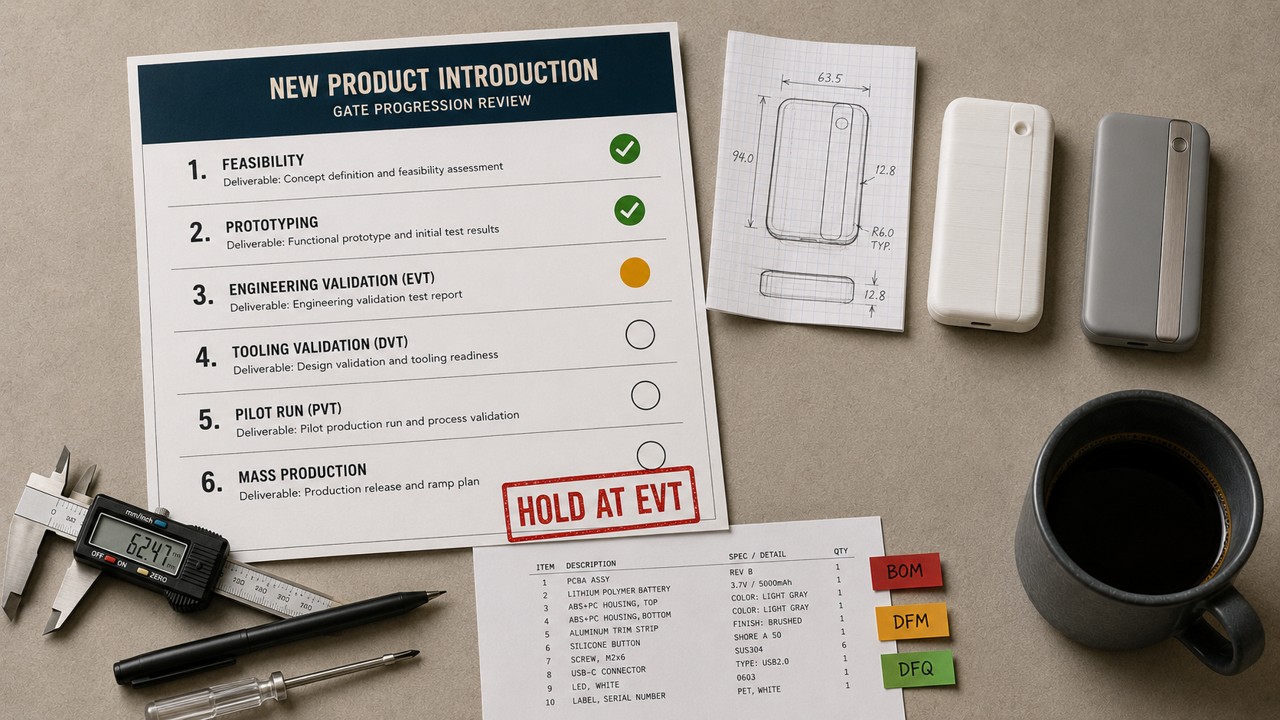
The discipline that separates the 10% from the 90% has a name. It is the New Product Introduction process, abbreviated NPI. NPI is a six-gate sequence that takes a product from concept through volume manufacturing. Each gate has specific deliverables. Each one closes a category of failure that has put crowdfunded products on the wrong side of those statistics.
This article walks through the six gates as they apply to a crowdfunded consumer-product creator with a manufacturing window opening in the next 90 days. The framework is adapted from established industrial practice and applies cleanly to the Kickstarter and Indiegogo audience, plus the product design firms working on their behalf.
Why crowdfunded hardware is structurally exposed to NPI failure
The crowdfunded creator carries four structural disadvantages relative to a corporate hardware launch.
The team is small. Most campaigns ship from four to eight people. No one on the team has run an NPI before. There is no senior QE on staff. No one writes the design-review documents that catch failures before tooling.
The manufacturing window is short. Backers paid nine months ago and they are watching. A three-month slip is a public-relations event. A nine-month slip is the end of the brand.
The reputation is public. Defects do not get absorbed into a retailer’s silent return rate. They surface in the campaign comments, on Reddit, and in YouTube tear-downs. The reputation hit compounds faster than a standard retail launch.
The cash arrives ahead of the design. Kickstarter releases campaign funds to the creator about three weeks after the campaign ends. From that point, the creator faces pressure to commit the cash to tooling before the design has frozen. Milestone-based payment structures exist and are negotiable with Chinese manufacturers, but a creator without supply-chain experience often commits the standard 30% to 50% tooling deposit early, before the gate that would justify it.
The 90% failure statistic is a corporate-context number. The crowdfunded version of it is rougher.
The six gates
The NPI process for a product under a roughly $1 million budget runs in six gates. Larger consumer-electronics companies (Apple and Motorola are the examples Sofeast cites) use a more rigorous variant with five named validation stages (POC, POD, EVT, DVT, PVT) before mass production. The six-gate version is correct for crowdfunded scale.
Gate 1. Feasibility study
The first gate locks the architecture. The output is a written feasibility report containing the design architecture, the key component selections, the major risk register, the BOM at the family level, and the cost target. Most failures at this gate look the same. The architecture gets fixed in a sketch or rendering before the engineering review. The actual constraints (cost target, regulatory exposure, supplier capacity, recall-history baseline) are not tested against the architecture until much later. The architecture has to survive each one of those constraints in writing before it leaves the feasibility gate.
Gate 2. Prototyping
The second gate produces a working prototype that meets the spec. Several iterations are expected. The output is a prototype that hits the performance spec and that the engineer is willing to freeze.
Two common failure modes at this gate. First, the team accepts a prototype that has been hand-finished by the factory and that will not survive the transition to tooling. Second, the team treats one good prototype as proof and skips the variance review. Three prototypes from the same line, measured against the spec sheet, tell the truth that one prototype does not.
Gate 3. Engineering Validation (EVT)
The EVT gate freezes the design. The output is a work-and-look-alike prototype approved against every line on the spec sheet, with the design package locked in writing. After EVT, any change becomes a change-order that costs tooling time and money.
The cost-of-defect curve steepens sharply at EVT. The 1-10-100 rule, used across NPI literature, frames the cost ratio. A defect caught at concept costs roughly one unit of effort to fix. The same defect at prototype costs ten. The same defect at mass production costs one hundred. The numbers are illustrative, the ratio is reproducible, and the EVT gate is where the curve crosses the line a small team can absorb.
Gate 4. Tooling Validation (DVT)
The tooling validation gate verifies that production tooling delivers the EVT spec. The output is a tooling-validated production sample, plus the process documents (control plan, work instructions, inspection criteria, operator training records) that the factory will use during volume production.
Three failure modes are common at DVT. The tooling is correct but the process drifts on the second shift and yield collapses. The tooling and process are correct, but operator instructions are ambiguous, and a different operator on the night shift builds the unit differently. The tooling is correct and the inspection criteria are loose, and defects that should have been caught pass into pre-production.
Gate 5. Pilot run (PVT)
The pilot run is a small production batch, typically a hundred to a few hundred units, built on the production line with the production tooling and the production process. The output is a measured first-pass yield, a measured cycle time, and a pilot-run inspection report.
A pilot run is not optional. The crowdfunded creator who skips PVT and jumps straight to mass production discovers the yield in the field and pays for the inspection in returns. Sofeast’s guide is direct on the threshold. Do not proceed to mass production if 5% or more of parts need rework at the pilot run.
Gate 6. Mass production
The final gate is the volume ramp. The output is a documented production batch with a defect rate inside the agreed limit and a documented process for handling out-of-spec units. Continuous process improvement runs from this gate onward, and a mature supplier has a process-capability review every quarter.
The four design reviews
Between gates 1 and 4, an NPI process runs four discrete design reviews. Each one closes a different category of failure. Skipping any of them is a common failure mode in the crowdfunded segment.
Design for Manufacturing (DFM). Can the design be built efficiently with standard processes and high yield? The DFM review reads the design against the factory’s actual equipment, tooling library, and process capability. Common DFM findings on crowdfunded products: tolerances too tight for the factory’s process, assembly steps that require operator skill the factory does not have, and components that look identical to standard parts but are slightly off-catalog and require custom sourcing.
Design to Cost (DTC). Can the design be built at the cost target? The DTC review tracks the BOM cost, the assembly labor, the manufacturer margin, and the logistics cost against the retail target. A common DTC finding: logistics is 30% of total cost, the founder budgeted 10%, and the unit economics do not survive freight.
Design for Quality (DFQ). Can the design meet the quality spec under foreseeable use, foreseeable misuse, and supply-chain stress? The DFQ review defines tolerances, stress-tests them, confirms process capability, and runs compliance testing. The DFQ review also pulls in the public recall record for comparable products and maps each documented failure mode to a design decision.
Design for Distribution (DFD). Can the design ship without taking damage in the supply chain? The DFD review optimizes packaging, validates drop testing, and runs the unit through transport simulation. A common DFD finding: the campaign-page renderer designed beautiful unboxing packaging that performs badly on a pallet.
Skipping any of these four reviews moves a defect from a 1-unit-of-effort fix to a 10-unit-of-effort fix or worse.
Where the Pre-Launch QA Audit fits in NPI
The Pre-Launch QA Audit at QESaaS sits between gate 1 and gate 4. The audit reads the BOM, the spec sheet, the prototype documentation, and the manufacturer’s track record, and produces a written report against the 10-point methodology before the design freeze.
Sections 1, 3, and 4 of the audit map directly to NPI gates.
- Section 1. Materials and Construction lives inside the DFM review. The audit produces a list of BOM lines that require a factory documentation request before EVT.
- Section 3. Failure Modes lives inside the DFQ review. The audit produces a ranked list of failure modes for the product category, with the public recall record behind each one.
- Section 4. Manufacturer Track Record is independent of the design and runs as soon as the manufacturer is named. The audit produces a recall and complaint history search against the named factory, pulled from CPSC, FDA, USDA, and NHTSA data.
The audit complements the four design reviews. It pulls them forward, adds external recall-history data the in-house team often lacks, and produces the written deliverable the founder forwards to the CEO, the board, the retailer’s vendor compliance team, or an investor group. The cost of the audit is small against the cost of catching the same defects at gate 4 or later.
Three buyer-side approaches
The crowdfunded creator can run NPI from three positions.
Hands-off. The factory or the product design firm runs the NPI process. The founder approves milestones and pays invoices. The founder has no independent visibility into the gates. This approach works when the supplier is mature and motivated. It fails badly when either condition slips.
Controlling. The founder writes detailed specifications, runs every design review, and inspects every milestone in person. This approach catches more defects but requires a senior QE on the founder’s team and a willingness to walk away from the factory if the gates are not met. Crowdfunded teams rarely have either resource.
Leading. The founder owns the NPI process at the architecture level and the gate-decision level, with senior external resources (a QE consultant, a third-party inspector, a sourcing agent, a regulatory specialist) called in for specific tasks. The founder retains decision rights at each gate. The factory executes. This is the model that fits the crowdfunded segment.
The Pre-Launch QA Audit is a leading-approach tool. The founder owns the gate decision. The audit produces the engineering data the founder needs to make the decision well.
The cost-of-defect curve
The 1-10-100 ratio is a useful frame. A defect caught at concept costs roughly one unit of effort. The same defect at prototype costs ten units. The same defect at mass production costs one hundred. The numbers are illustrative. The ratio is reproducible and well-documented across the NPI literature.
For a crowdfunded creator, a unit of cost is broader than dollars. It includes calendar time, public reputation, founder bandwidth in the launch window, and customer-service load on a small team. A defect that surfaces in fulfillment costs a fix-engineering pass, a logistics reroute on returns, a customer-service queue, a campaign-page-comment thread, and a reputation hit that outlives the launch.
The argument for running every gate properly is not academic. The argument is that a creator who runs the gates pays the cost-of-defect at the cheap end of the curve. A creator who skips them pays at the expensive end.
How to apply this guide
A creator with a manufacturing window opening in the next 90 days can use this guide directly:
- Read the six gates against the current product. Identify which gate the product is at today.
- Confirm the deliverables for every prior gate. If a deliverable is missing, decide whether to backfill or proceed with the documented gap.
- Schedule the four design reviews against the current calendar. If the team lacks the in-house discipline to run them, engage outside resources.
- Book the Pre-Launch QA Audit before the EVT gate. The audit produces the failure-mode and manufacturer-track-record reads that an in-house team rarely has time to produce.
- Run the pilot run before mass production. Treat the 5%-rework threshold as a hard gate.
10 to 15 pages of PDF. One week. $1,500 fixed, $750 for the first three engagements in exchange for a written testimonial. Scoping calls are free. If the product’s NPI state cannot be read clearly from the documentation you can send, we will say so on the scoping call before any invoice is sent.
Full audit detail: qesaas.com/services-pre-launch-audit. The 10-point methodology: qesaas.com/the-qa-audit.
Source for the NPI framework adapted in this article: Sofeast, “New Product Introduction Process Guide”. The framework above is adapted for the crowdfunded segment, with the failure-mode reads, public-record citations, and audit-integration framing added.
If you are in the pre-PO window with a manufacturing window opening in the next 90 days, send your spec sheet and a description of your current NPI state.
Want this kind of analysis on a product you're shipping or a regulatory situation you're sitting in? Email Mark or book a scoping call. Initial conversations are free and NDA-able.
← All articles