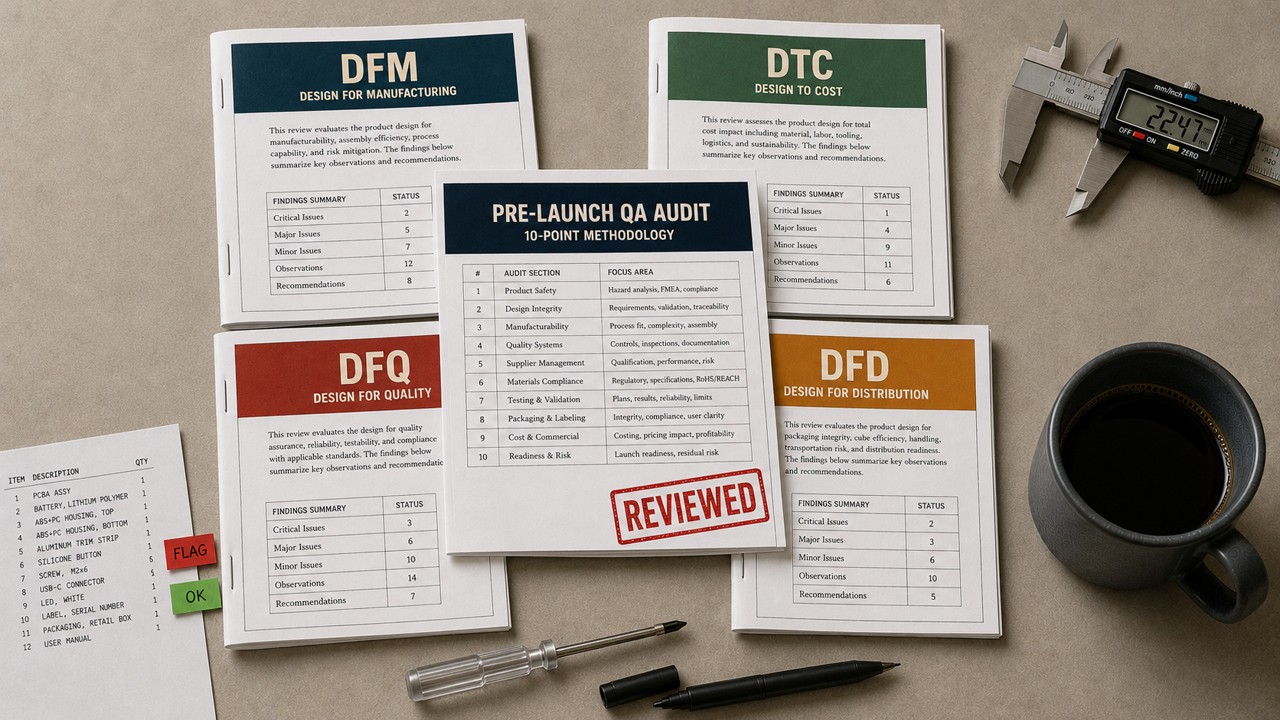
The six-gate NPI process for a crowdfunded consumer product runs four discrete design reviews between the feasibility gate and the tooling-validation gate. Each one examines the product through a different lens. Each one closes a category of failure that has put crowdfunded products on the wrong side of fulfillment.
The four are Design for Manufacturing (DFM), Design to Cost (DTC), Design for Quality (DFQ), and Design for Distribution (DFD). The terms are industry-standard and well-documented throughout the quality industry.
This article walks through each review in detail. Where it applies to a Kickstarter or Indiegogo creator. What the typical failure looks like before the review and what the deliverable looks like after. How the Pre-Launch QA Audit at QESaaS reads each one against published failure modes the in-house team often does not have time to research.
What a design review actually is
A design review is a written examination of a product specification by a senior engineer who is not the design author. The review reads the spec sheet, the bill of materials, the prototype documentation, and any test data against a specific category of failure. The output is a written report of what the design covers, what it does not, and what changes the engineer recommends.
A design review is not a meeting. The output of a design review is a document the founder can forward to a CEO, an investor group, a retailer’s vendor compliance team, or a contract manufacturer. Meetings happen around the document.
The review’s value comes from the independence of the reviewer. A senior engineer reading their own design will miss the failures the engineer who wrote it has been staring at for six months. The four design reviews each apply a different filter to the same set of inputs.
1. Design for Manufacturing (DFM)
DFM asks one question. Can the design be built efficiently with standard processes and high yield in the actual factory that will produce it?
Typical DFM findings on crowdfunded products:
- Tolerances tighter than the factory’s process can hold reliably. A spec sheet that calls for ±0.05 mm on a feature the factory builds at ±0.15 mm produces a high rejection rate at first article and a fight with the factory over who pays for the rework. Some research articles document rejection rates as high as 80% on a first batch when tolerances are set without consulting the factory’s actual process capability.
- Assembly steps that require operator skill the factory does not have. The campaign-page video shows the assembly done by an experienced engineer in a clean room. The production line is staffed by operators on a 30-second cycle time. Steps that take 30 seconds in the video take 90 seconds on the line, and the unit economics collapse.
- Components that look identical to standard parts but require custom sourcing. The BOM lists a fastener as “M3 stainless screw.” The actual spec on the prototype is “M3-0.5x6 A2-70 socket cap with bonded patch.” The fastener is six times the price of the standard part, available from one US distributor, with a four-week lead time.
- Sub-assemblies the prototype shop hand-finished. The prototype shop polished a seam that the production process cannot reach. The first production unit ships with the seam visible. Customer service handles the rest.
The DFM deliverable is a written report on the BOM against the factory’s actual equipment, tooling library, process capability, and operator skill. A typical DFM report on a Kickstarter-grade product runs five to eight pages and lists between 15 and 40 specific findings, each ranked by impact.
The Kickstarter creator who skips DFM ships the design that survived the prototype shop and discovers in the field which features the factory could not actually build.
2. Design to Cost (DTC)
DTC asks one question. Can the design be built at the cost target with the unit economics surviving freight and fulfillment?
The DTC review tracks four cost categories against the retail target.
Bill of materials cost. Each line on the BOM at the supplier’s quoted price for the production volume, with realistic lead times and minimum order quantities. Hidden costs at this stage are custom components priced at single-unit quotes, components ordered in MOQs that exceed the production run, and components priced before currency or tariff volatility.
Assembly labor. Cycle time on the production line, with the actual operator pay rate, the actual line yield, and the actual rework load. In some instances an 8-minute estimated assembly time ran for 30 minutes or more in production because of testing instability, operator confusion, rework cycles, and tooling adjustments at startup. The labor delta becomes real money at production volume.
Manufacturer margin. A Chinese contract manufacturer expects payback within 6 to 12 months of accepting the project. The margin on the unit price reflects the time-to-payback math. A founder who negotiates the margin down without understanding the math will discover the factory deprioritizes the order during ramp.
Logistics and fulfillment. Logistics often represents 30% of total cost. A crowdfunded creator who budgets 10% for international freight, customs duties, 3PL fulfillment, and last-mile delivery discovers the unit economics do not survive freight on the first international shipment.
The DTC deliverable is a written cost model with each category broken out, the assumptions named, and the sensitivity to the most likely cost drivers (freight rate, currency, tariff schedule, MOQ thresholds) tested explicitly. The model has to be readable by a non-engineer board member or investor.
The Kickstarter creator who skips DTC discovers in fulfillment that the retail price the campaign sold at has a negative margin once freight and 3PL costs land. There is no graceful recovery from this discovery.
3. Design for Quality (DFQ)
DFQ asks one question. Can the design meet the quality spec under foreseeable use, foreseeable misuse, and supply-chain stress?
The DFQ review is the senior-QE specialty. It runs four sub-analyses.
Tolerance and stress test. Every measurable claim on the spec sheet (load rating, water resistance, battery life, thermal cycle count, drop survival) is tested against the published standard, with the test data documented and the result mapped to the production tolerance band.
Failure mode analysis. Each subsystem is examined for foreseeable failure modes under normal use and foreseeable misuse. The standard FMEA dimensions (severity, occurrence, detection) are scored for each mode and a documented design mitigation is recorded.
Recall record reading. The public recall record for comparable products is pulled from CPSC, FDA, USDA, and NHTSA databases and clustered by failure mode. Each documented failure mode in the category is mapped to a specific design decision in the product. If a recall vector exists in the category and the design does not address it, the audit flags it.
Compliance verification. The regulatory map for the product (UL or ETL listing, FCC, CPSC certification, FDA registration where applicable, prop-65, regional variations) is built. The supplier’s test report scope is checked against it. Gaps are listed.
The DFQ deliverable is the deepest of the four reviews. It typically runs 10 to 15 pages on a crowdfunded product and includes the failure-mode register, the test-data summary, the recall-record cluster, and the regulatory-exposure map.
The Kickstarter creator who skips DFQ ships into a public audience that posts the first failure mode on r/Kickstarter inside 72 hours. The reputational compounding from a public defect is much faster than the equivalent fault at a retail launch.
4. Design for Distribution (DFD)
DFD asks one question. Can the design ship from the factory to the consumer’s hands without taking damage in the supply chain?
The DFD review covers four areas.
Packaging design and protection. The packaging absorbs the shocks the product cannot. The DFD review reads the packaging spec against the actual transport stresses (drop, vibration, compression, humidity, temperature). The campaign-page renderer who designed unboxing packaging that looks beautiful on Instagram often produces a carton that performs badly under a 1-meter drop test.
Stack and pallet design. Cartons stack on pallets and pallets stack in containers. The compression load on the bottom unit in a stack is real, and the carton has to survive it. Combining two parts into one mold cuts cost by 30% in one example. Reducing the number of Velcro shapes from four to two cuts tooling cost and unit cost.
Transport simulation. The unit is run through a transport-simulation test (drop, vibration, compression, climate) and the failure rate is documented. A 5% damage rate at transport simulation is a 5% return rate in fulfillment.
Documentation and labeling. The labels, the manuals, the warranty cards, the safety inserts, and the regulatory marks are all in the box. Each one has to survive the supply chain and be readable by the consumer at unboxing.
The DFD deliverable is the packaging spec, the drop-test data, the stack-load data, and the transport-simulation report. A typical DFD report runs three to five pages.
The Kickstarter creator who skips DFD ships the campaign-page packaging and pays the return rate in fulfillment. International returns on damaged units are particularly expensive because the consumer ships back at the creator’s expense in most jurisdictions.
How the Pre-Launch QA Audit operationalizes all four reviews
The Pre-Launch QA Audit at QESaaS runs the 10-point methodology and produces the engineering deliverable in one week. Each section of the audit maps to one or more of the four design reviews.
| Audit Section | DFM | DTC | DFQ | DFD |
|---|---|---|---|---|
| 1. Materials and Construction | x | x | x | |
| 2. Tolerances and Specifications | x | x | ||
| 3. Failure Modes | x | |||
| 4. Manufacturer Track Record | x | x | ||
| 5. Category Recall History | x | |||
| 6. Regulatory Exposure | x | |||
| 7. One-Star Review Patterns | x | x | ||
| 8. Returns and Warranty Reality | x | x | ||
| 9. Comparable Products | x | x | x | x |
| 10. Risk-Ranked Verdict | x | x | x | x |
The audit does not replace the four design reviews. It pulls them forward, adds external data (public recall history, federal compliance databases, comparable-product complaint records) the in-house team often lacks the time to research, and produces a single written report that a senior reviewer would otherwise produce by running all four reviews in parallel.
The audit’s value is in the timeline. A traditional four-design-review pass runs four to eight weeks of senior-engineer time at boutique consultancy rates of $20,000 to $50,000 per engagement. The Pre-Launch QA Audit runs in one week for a fixed $1,500, or $750 for one of the first three engagements in exchange for a written testimonial. The published 10-point methodology is the same audit on every engagement, with the findings tailored to the specific product.
A self-audit checklist before booking
A creator with a manufacturing window opening in the next 90 days can run the four reviews as a self-audit before booking the Pre-Launch QA Audit:
- Has the BOM been read against the factory’s actual process capability? (DFM)
- Is the unit cost target backed by a written cost model that includes international freight, customs duties, 3PL fulfillment, and last-mile delivery? (DTC)
- Is there a written failure-mode register and a public-recall-record read for the product category? (DFQ)
- Has the packaging been drop-tested and stack-load-tested? (DFD)
Three or more “no” answers means the design has structural gaps that should close before EVT. One or two are usually fixable with explicit follow-up work in writing. The audit reads the inputs the creator already has and produces the missing engineering documentation in one week.
10 to 15 pages of PDF. One week. $1,500 fixed, $750 for the first three engagements in exchange for a written testimonial. Scoping calls are free. If the documentation makes the audit impossible to run usefully, we say so on the scoping call before any invoice is sent.
Full audit detail: qesaas.com/services-pre-launch-audit. The 10-point methodology: qesaas.com/the-qa-audit. The six-gate NPI framework these four reviews sit inside: npi-process-crowdfunded-hardware.
If you are in the pre-PO window with a manufacturing window opening in the next 90 days, send your spec sheet, your BOM, and your packaging spec.
Want this kind of analysis on a product you're shipping or a regulatory situation you're sitting in? Email Mark or book a scoping call. Initial conversations are free and NDA-able.
← All articles